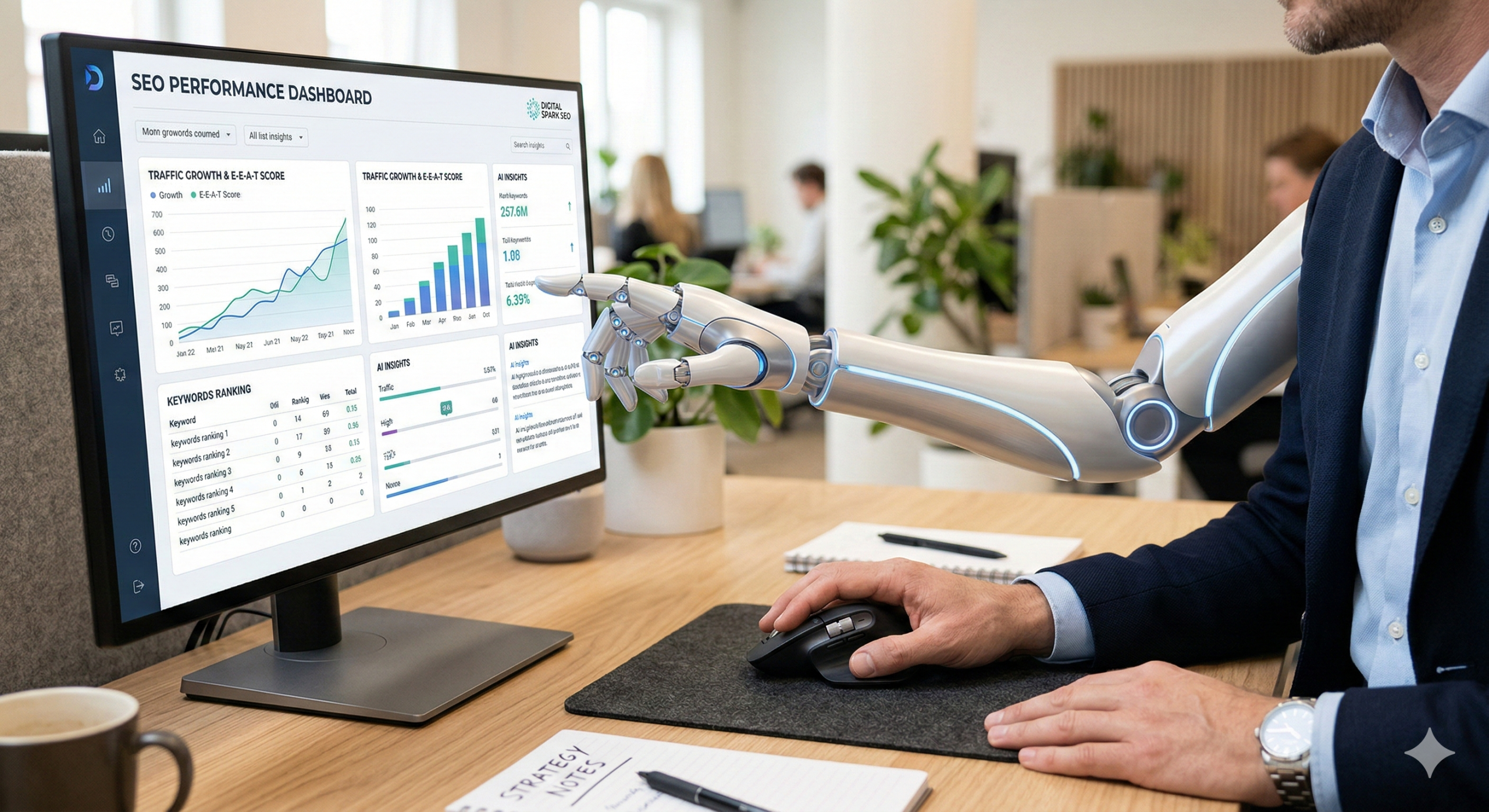

The internet is currently facing an unprecedented explosion of content. With the rise of Generative AI, every business owner now has what looks like a magic wand — the ability to produce articles, product descriptions, and blog posts in seconds. But here’s the cold, hard truth:
When everyone can produce ‘average’ content for free, ‘average’ no longer ranks. The bar for quality hasn’t been lowered by AI — it’s been raised.
Most businesses are rushing to automate their blogs, only to find their organic traffic stagnant or quietly dropping. And they’re confused — they followed the playbook. They used the tools. Why isn’t it working?
In this article, we break down exactly what goes wrong, what the winning 10% does differently, and what it means for your business.
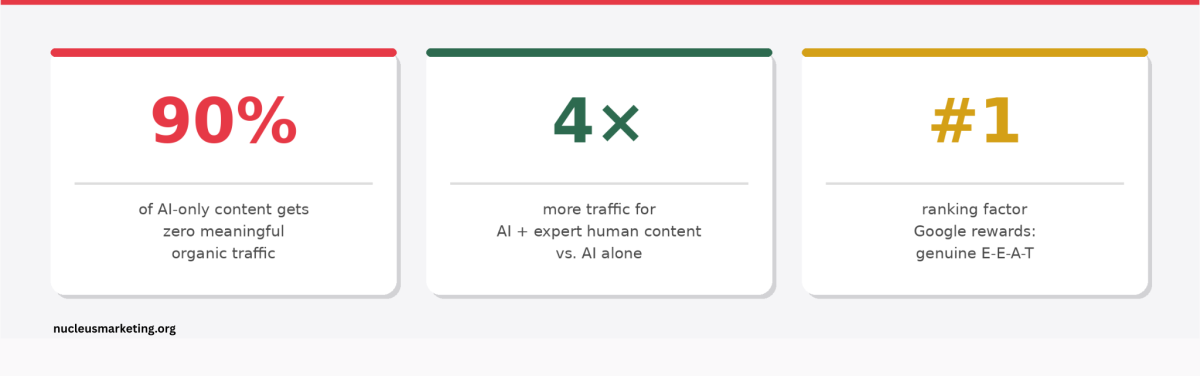
Google’s algorithm has one job: deliver the most useful, credible, and genuinely helpful result for every search query. Over the past three years, it has become significantly better at identifying content that only appears to be useful — content that covers the right keywords but doesn’t actually serve the reader.
Raw, unedited AI output fails this test for three interconnected reasons:
Google’s quality guidelines prioritize Experience, Expertise, Authoritativeness, and Trustworthiness. These aren’t abstract ideals — they’re signals Google actively measures through backlinks, author credentials, content depth, and user behavior.
AI can simulate information. It cannot simulate 10 years of eCommerce experience. It cannot reference the specific platform migration that tanked a client’s traffic for six weeks and what fixed it. It cannot bring the earned authority of a team that has seen hundreds of search landscapes shift in real time.
Google measures something called ‘information gain’, how much new, useful insight a piece of content adds compared to what already exists on the topic. If your article says exactly what the top 10 results already say, reorganized into slightly different sentences, Google has no reason to rank you above them. AI excels at summarizing the past. It cannot invent a fresh perspective, offer proprietary data, or share what your specific webshop experienced last Black Friday. That kind of specificity is what earns rankings.
Accuracy is a trust signal — and trust is a ranking factor. Without a human expert to fact-check, AI can confidently state outdated statistics, misquote research, or fabricate details that seem plausible but aren’t true. One high-profile factual error can damage your brand’s credibility far more than a content gap ever would.
Google isn’t punishing AI content. It’s rewarding genuinely useful content — and most AI content, without expert oversight, simply isn’t that.
The AI-assisted content that actually dominates search results follows a specific, repeatable blueprint. It isn’t about which AI tool you use — it’s about how human expertise wraps around it at every critical stage.
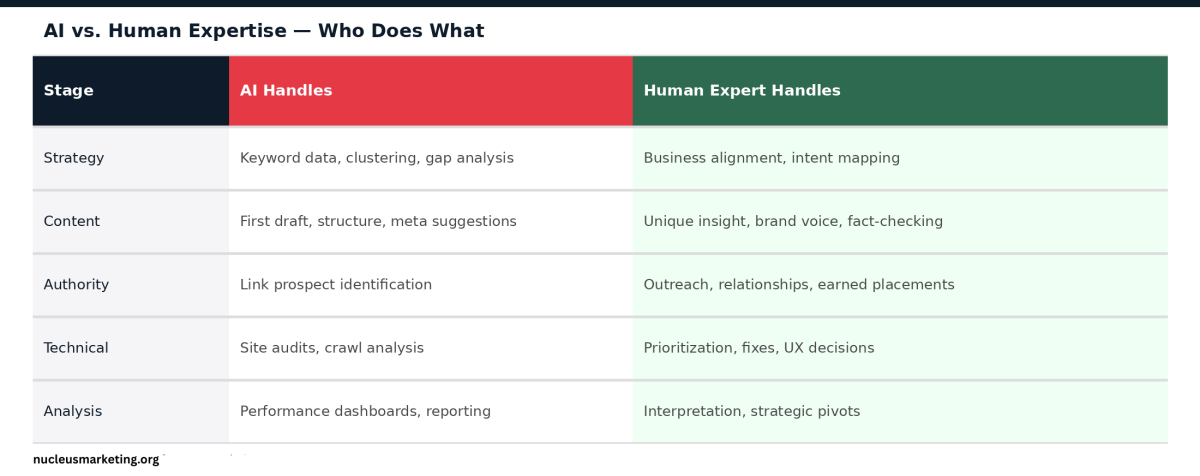
We use AI to crunch data, generate outlines, and overcome the blank-page problem at scale. But the soul of each piece — the strategy, the tone of voice, the unexpected angle that makes someone share it, is strictly human.
This isn’t a compromise. It’s the most efficient way to produce content that is both fast and genuinely good.
The content that ranks consistently isn’t generic. It contains real-world context: case studies, platform-specific experience, and proprietary observations that competitors cannot simply replicate. AI cannot know how a specific product category performed during a seasonal promotion or why a particular category page needed a complete UX overhaul. A dedicated expert can — and that difference shows up in rankings.
Great content published on a slow, poorly structured website will underperform every time. Page speed, mobile experience, internal linking, crawlability, structured data; these are not optional extras. They are the infrastructure your content depends on to rank.
We pair AI-assisted content production with high-end eCommerce and website development to ensure the technical foundation is as strong as the content itself.
For eCommerce businesses, SEO isn’t just about traffic. It’s about trust, and trust converts. A product description that reads like it was generated by a machine will subtly undermine confidence at the exact moment a visitor is deciding whether to buy. Robotic language, generic feature lists, and zero emotional resonance kill conversions before they happen.
In a sea of bots, authenticity is your greatest competitive advantage. Customers are becoming increasingly skilled at recognizing AI-generated content and they vote with their wallets.
If you’re already using AI for content production, answer these five questions honestly:
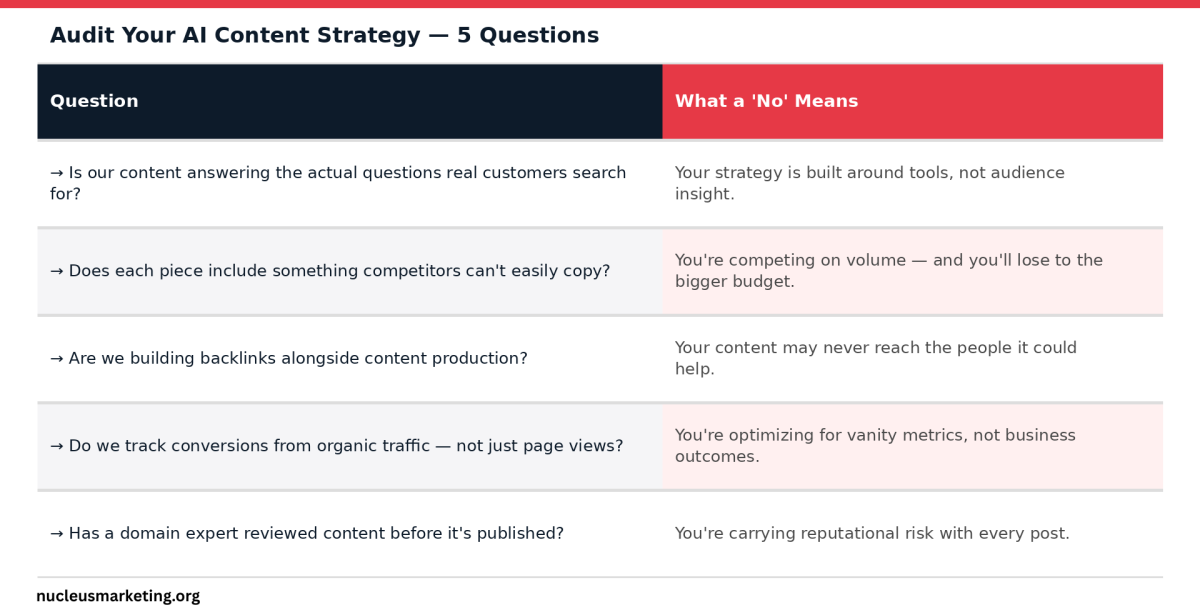
If you answered ‘no’ or ‘unsure’ to more than two of these, your current AI content strategy has meaningful gaps, and is likely leaving significant revenue on the table.
AI is a powerful engine. But even the most powerful engine needs a skilled driver to navigate the complexities of search algorithms, human psychology, and competitive landscapes.
The future of SEO isn’t ‘AI vs. Human.’ It’s humans using AI to build better, faster, more authoritative experiences – at a scale that wasn’t possible before.
The businesses growing through organic search right now aren’t necessarily publishing more content. They’re publishing better content – and they’re using AI to do it faster, not to replace the thinking behind it.
At Nucleus Marketing, we don’t use AI to replace our SEO and eCommerce specialists. We use it to make them 10× more effective – so every hour of expert time goes further, and every piece of content we produce is built to last.
Don’t just generate content, build a search strategy that lasts. Partner with us to combine cutting-edge AI technology with the unmatched expertise of our SEO and eCommerce specialists. Contact us today for a free SEO consultation and let’s unlock your true digital potential.